BDD chawl blocks
Serious MenThe BDD chawl blocks are a dense, aging residential complex in Mumbai, built as a refuge for the homeless but later turned into a prison and, generations afterward, home to tens of thousands. Their one-room dwellings and crowded common spaces organize the daily lives of residents, including Ayyan Mani and his family. The blocks are more than a setting: they make visible the pressures of poverty, the strength and limits of neighborhood solidarity, and the difficult prospect of escaping the circumstances into which one was born.
Built Form and History
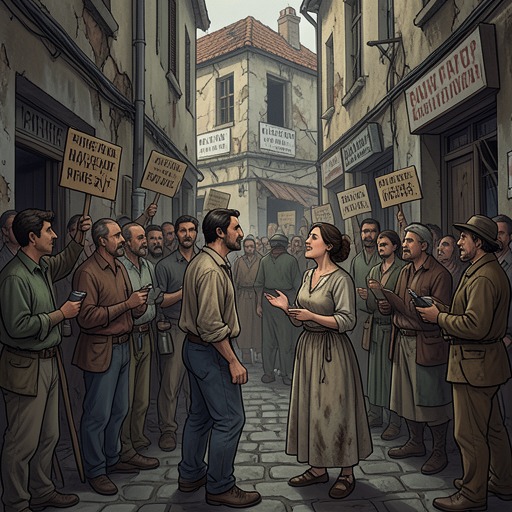
The complex consists of 120 identical three-storeyed buildings, within which roughly ten thousand one-room homes are packed together. Old rains have stripped away the paint, and the buildings stand like grey ruins. Clothes hang from the grilles of small, dark windows; sections of outer walls and sometimes roofs fall away, especially during the severe August rains. The scale is immense, but the individual homes offer little space or privacy.
The British built the chawls more than eight decades ago in what the narrative describes as a belated attempt to house the homeless. Their poor construction made them so unattractive that street dwellers initially refused to move in: a small, dark room and an endless corridor seemed no better than surrendering the open world. The buildings were then converted into gaols for freedom-fighters, and the unclaimed rooms became cells. By the time of the novel, the former prison complex housed more than eighty thousand people. Its history therefore runs from failed housing scheme to confinement to densely occupied neighborhood, without losing the physical marks of neglect.
Crowding and Domestic Life
Life in the chawls is shaped by the contrast between the smallness of each dwelling and the size of the community pressed into the buildings. Families may include children, elders, siblings, nephews, and nieces under a single roof; some rooms shelter more than a dozen people. Couples sometimes use wooden lofts for a measure of privacy, with the tacit understanding that relatives below will not look up. In homes with more than one married couple, the elevated sleeping space may be shared by turns. The loft is thus practical, but it also signals how little room families have to themselves.
The corridors are part of the residents’ domestic world. On the top floor of Block Number Forty-One, around forty doors open onto a dim passage marked by cracked, pale-yellow walls. People sit in doorways, older residents comb their hair, and children run along the old stone floor. Outside, the steep colonial stairways and broken, cobbled paths bring neighbors into continual view of one another. Private life is never entirely separate from the surrounding community.
Ayyan’s memories and habits are bound to this environment. He was born on a cold floor in the chawls and, at thirty-nine, still returns to them as home. He climbs the stairs, greets men on their way out to drink, and talks with old acquaintances on the tar-coated terrace about cricket, potential property buyers, and public figures. The men remember a common childhood and regard him with affection, yet Ayyan has also tried to cut himself off from their world. He sees their fellowship as limited by the wish to outdo one another, and their resentment at his progress confirms how far he has traveled from the life they share.
Family, Privacy, and Ayyan’s Position
The chawls’ cramped arrangements give ordinary milestones a particular meaning. A young couple descending the stairs with a travel bag are understood by Ayyan to be newly married; the bag is empty, but it signals a temporary escape and a private day together. Some couples make similar trips to inexpensive lodgings, presenting themselves as tourists. Ayyan’s own household followed a different path. After his three brothers died within eighteen months, followed by his father and then his mother, Oja Mani entered his life when he was twenty-seven and she was seventeen. With his family gone, he did not have to negotiate a crowded home in the same way as many other couples.
Years later, Ayyan builds an attic in his home. Its construction brings him a secret sense of pride, because he had not expected to build one himself. In the chawls, lofts are common responses to the need for sleeping space and privacy, and Ayyan recognizes the attic as a familiar feature of a life that has not been escaped. His version is about six feet by three, with a thin mattress, a blue table fan, and books that Oja would rather discard. When he leads her up the folding ladder, the space becomes a private setting within a home otherwise shaped by scarcity.
The blocks also frame family vulnerability. Oja’s distress about Adi’s hearing leads her to connect his condition with the absence of gods, while Ayyan angrily rejects the thought. At school, Adi’s hearing aid is part of the appearance through which others interpret him. When a newspaper reports that he can recite the first thousand prime numbers, residents gather around the copy in the toilet queue; Ayyan explains what prime numbers are, and neighbors respond with a mixture of affection, respect, and incomprehension. The story’s public portrait of a child genius reaches the chawls through a newspaper, but its meaning is negotiated in the shared spaces of everyday life.
Residents and the Contested Future
The blocks are not a unified community with a single view of its future. Builders periodically approach residents, hoping to buy the extensive property and replace the low-rise buildings with promised high-rises. At one nighttime meeting, more than a hundred residents gather on a terrace with the builders’ agents. Some want to sell quickly; others believe waiting could bring a better offer. Some fear they would not manage in apartment towers, while others insist that families accustomed to living together should receive adjacent flats in any redevelopment.
Ayyan wants to sell but expects no agreement soon. The residents’ competing needs make collective action difficult: hesitation, impatience, and differing expectations reinforce one another. The proposed high-rises promise a different physical arrangement, but the objections are also about the loss of familiar connections. One resident worries that apartment living would require keeping doors shut; another argues that long-standing ground-floor neighbors should remain together. The meeting leaves the complex’s future unresolved, with no shared decision strong enough to overcome disagreement.
Narrative Significance
The BDD chawl blocks place Ayyan’s ambitions beside the conditions he is trying to outgrow. He values the crowded city as a place where rich and poor alike must share public space, yet he does not confuse that momentary proximity with equality or friendship. Within the chawls, the cramped rooms, common corridors, and contested property make material constraint unavoidable. Ayyan’s progress distinguishes him from childhood companions, but his continued return to the blocks keeps his origins present in the story.
The complex also links separate scales of social life. A damaged building and a crowded room define the limits of privacy at home; a terrace meeting turns ownership into a neighborhood-wide dispute; a newspaper article carries Adi’s manufactured reputation into a morning queue. These movements between domestic space, communal gathering, and public recognition make the blocks an active part of the narrative. They are at once a place of confinement and attachment, a home sustained by residents’ shared routines, and a property whose possible transformation threatens to divide those residents over what a better future would mean.